Search Bar You Knew Is Gone Google AI Search 2026
There’s a version of Google Search you’ve used your whole life. You type a query. You get ten blue links. You click. You browse.
That version is over as Google AI Search 2026 comes up.
In one of the most significant platform overhauls in Google’s history, the company has embedded Gemini — its most advanced AI model family — into every layer of its ecosystem. Search, Chrome, Gmail, Docs, Workspace, and even your smartwatch are being rebuilt around a single principle: AI should eliminate the distance between intent and outcome.
The result is a fundamentally different internet experience. One where the search box anticipates your next question. Where your browser completes multi-step tasks without you touching the keyboard. Where a background AI agent manages your inbox, calendar, and deadlines before you’ve had your morning coffee.
For everyday users, it’s a leap in convenience. For marketers, content strategists, and brand builders — it’s a five-alarm wake-up call.

Let’s break down exactly what Google announced, why it matters, and what your funnel strategy needs to look like on the other side of this shift.
What Google Actually Announced?
Gemini 3.5 Flash: The Speed Engine Behind Everything
The foundational change powering this entire rollout is Gemini 3.5 Flash — Google’s latest and fastest model, now integrated across Google Search and the Gemini app.
The headline number: AI-powered responses up to four times faster than before. But the speed improvement isn’t just a performance metric. It’s what makes every other feature in this list feel real. Conversational search only works if the AI responds at the pace of thought. Agentic automation only feels natural if actions complete in seconds, not minutes.
Gemini 3.5 Flash is the infrastructure upgrade that makes the rest of this possible.
AI Mode and the Intelligent Search Box
The iconic Google search bar — unchanged in its core function for over two decades — has been fundamentally redesigned.
In its new form, the search box anticipates your intent as you type, surfacing conversational follow-up queries before you’ve finished your sentence. Think of it as autocomplete, but instead of finishing your words, it’s finishing your thought process.
More significantly, AI Overviews — the summarized AI responses that have increasingly appeared at the top of search results — can now be expanded into a full back-and-forth conversational chat without losing context. You ask a question, get an AI answer, ask a follow-up, get a deeper answer, and the thread holds together like a dialogue.
This is Google’s direct answer to the conversational AI interfaces pioneered by ChatGPT and Claude. The difference is that Google’s version is anchored to real-time search data and sits inside the world’s most-used information platform.
For users, this is genuinely powerful. For marketers, it signals something much more disruptive: your content may now be consumed without a single click to your website.
Chrome Becomes an Autonomous Browsing Agent:
Google Chrome — already the world’s dominant browser — is gaining a set of capabilities that transform it from a passive browsing tool into an active task-completion agent.
Gemini in Chrome for Android now functions as an on-screen assistant that can summarize long articles, answer contextual questions about the page you’re on, and perform small but meaningful actions — like adding recipe ingredients directly to Google Keep without you leaving the page.

Auto Browse takes it further. If you have a ticket to an event, you can ask Chrome to look up the event details, find available parking nearby, and complete the booking — automatically. No new tabs. No form-filling. No back-and-forth navigation. You describe the goal; Chrome executes the task.
Skills in Chrome lets desktop users save complex, multi-tab AI prompt workflows — like comparing product specifications across multiple competitor sites — and trigger the entire workflow again later with a single click. Repetitive research tasks become one-tap operations.
And then there’s Nano Banana — a creative tool built into Google Lens and AI Mode. Users can highlight text or select portions of an image on any webpage and instruct the AI to transform it: “Turn this page into an infographic,” “Reformat this table as a comparison chart,” “Redraw this diagram with a different visual style.” It brings a layer of real-time content transformation directly into the browsing experience.
Workspace Gets Voice, Memory, and a Background Agent:
Google’s productivity suite — Docs, Gmail, Calendar, and the rest of Workspace — is receiving the most comprehensive AI upgrade in its history.
Docs Live introduces advanced conversational voice drafting. You can speak naturally — even if your thoughts are disorganized, mid-sentence corrections, or rambling — and the AI will structure your dictation into coherent, formatted document content in real time. It’s not voice-to-text. It’s voice-to-structured-draft.
Gmail Live brings voice-first inbox management. You can search, filter, summarize, and navigate your email entirely hands-free while commuting, walking, or working with your hands occupied. The inbox becomes an audio interface.
Both features signal a clear directional shift: Google is designing Workspace for a world where keyboard input is optional, not required.
The most ambitious Workspace announcement, however, is Gemini Spark — a 24/7 personal AI agent available to Google AI subscribers. Spark connects deeply across all Workspace apps and operates proactively in the background, surfacing urgent emails, flagging approaching deadlines, and handling coordination tasks before you ask it to. It’s less an assistant and more a chief of staff — one that never sleeps, never misses an email, and never forgets a deadline.
Wear OS 7: The AI Moves to Your Wrist:
Wear OS 7 brings Android 17’s Live Updates to smartwatches, enabling real-time delivery and ride tracking with persistent, glanceable notifications. But the more significant addition is Gemini Intelligence for Wear OS — the ability to initiate basic task automation directly from your watch.
This completes a loop Google has been building toward for years: AI-driven actions available at every point of contact with technology, from desktop to mobile to wrist, with no friction between intent and execution.
Universal Cart: One Checkout for the Whole Internet: Universal Cart allows users to drop shopping items from entirely different online retailers into a single, unified digital cart directly within Google’s ecosystem. Browse a product on one site, find a better version on another, add both — and check out once.
The implications for e-commerce are significant. Google is positioning itself as the checkout layer of the internet, not just the discovery layer.
Funnel Has Changed. Here’s What That Means.
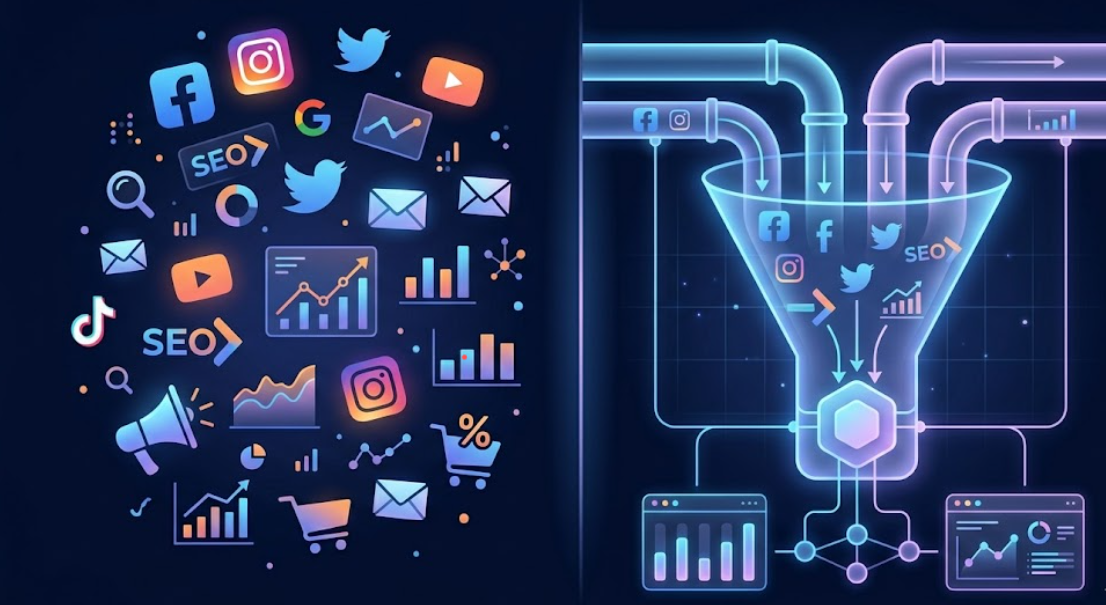
Everything Google announced points toward the same structural shift: the distance between search intent and final outcome is collapsing.
The traditional digital marketing funnel assumed multiple touchpoints. User searches → user sees results → user clicks → user browses → user converts. Each step was an opportunity to capture attention, build trust, and guide behavior.

That model is being compressed. Potentially eliminated.
Here’s what each major announcement means for your marketing strategy:
AI Mode and conversational search mean your target audience may get a complete answer — sourced from your content, or someone else’s — without ever landing on your website. Traffic numbers will fall even as brand influence potentially grows. Visibility in AI-generated answers is the new first-page ranking.
Auto Browse and agentic task completion mean that for transactional queries — booking, buying, scheduling, comparing — the user’s journey may complete entirely within Google’s interface. Your website becomes less of a destination and more of a data source that Google’s AI pulls from.
Gemini Spark as a background agent means that for B2B brands targeting decision-makers, your content now needs to be surfaced in an AI summary before it reaches a human. If Spark filters, summarizes, and prioritizes on behalf of busy professionals, your brand needs to be legible to AI readers, not just human ones.
Docs Live and Gmail Live normalize voice-first information consumption. Long-tail, conversational, question-based keywords — the kind that match how people actually speak — will carry more weight than exact-match keyword targeting.
Universal Cart signals that Google wants to own the e-commerce checkout experience. For product-based brands, this means optimizing your Google Merchant feed is no longer optional — it’s the primary commercial interface.
BuzzMora POV – Google AI Search 2026
Google isn’t just adding AI features — it’s restructuring the entire intent-to-action pipeline. Every announcement tightens the loop between what a user wants and what actually happens. For marketers, the implication is stark: the classic search funnel has been compressed. AI Mode means users may never see a results page. Auto Browse means they may never visit your site. Gemini Spark means they may never read your email directly.
The brands that will win on the other side of this shift are the ones who stop optimizing for clicks and start optimizing for AI citation. The question isn’t whether Gemini will change your SEO strategy. It’s whether your content is structured well enough, authoritative enough, and answer-dense enough to earn a place in the conversation — before the click ever happens.

At BuzzMora, we’ve been building toward this reality. AEO-first content architecture, funnel-mapped answer structures, and trust-signal content aren’t future strategies anymore. They’re survival requirements.
What Marketers Should Do Right Now?
- Audit your content for AEO readiness. Every page on your site should directly answer the questions your audience is searching. If it takes three paragraphs to get to the answer, the AI will skip you for someone cleaner.
- Structure your content for AI citation. Use clear H2/H3 hierarchies, direct answer sentences at the top of each section, and FAQ blocks that mirror real conversational queries. You’re no longer writing for humans who skim — you’re writing for AI that extracts.
- Rethink your success metrics. Organic traffic may decline even as brand visibility grows. Start tracking AI Overview appearances, branded search volume, and share-of-voice in AI-generated answers. Clicks are becoming a vanity metric.
- Build your Google ecosystem presence. Universal Cart, Gemini Spark, and AI Mode all pull from Google’s data infrastructure. Your Google Business Profile, Merchant feed, and Knowledge Panel need to be complete, accurate, and updated.
- Start treating voice as a content channel. With Docs Live and Gmail Live normalizing spoken queries, produce content that maps to how people talk, not just how they type. Conversational long-tail keywords are your new primary targets.
FAQs – Google AI Search 2026
Q: What is Google’s AI Mode in Search?
AI Mode transforms the Google search bar into a conversational interface. It suggests follow-up queries as you type and allows users to expand AI Overviews into a full back-and-forth chat without losing context — making search feel like a dialogue rather than a keyword lookup.
Q: How does Gemini 3.5 Flash change Google Search?
Gemini 3.5 Flash delivers AI-powered responses up to four times faster than previous models. It powers the real-time responsiveness behind AI Mode, conversational search, and agentic task completion across Google’s platforms.
Q: What is Gemini Spark and who is it for?
Gemini Spark is a 24/7 background AI agent for Google AI subscribers. It connects across Workspace apps to proactively surface urgent emails, flag deadlines, and handle coordination tasks autonomously — functioning like a personal chief of staff inside your productivity suite.
Q: What is Auto Browse and how does it work?
Auto Browse is a Chrome feature that allows users to delegate multi-step browsing tasks to the browser. You describe the goal — such as finding and booking parking for an upcoming event — and Chrome navigates, researches, and completes the action automatically.
Q: What does Google’s AI Search overhaul mean for SEO?
The shift toward AI-generated answers and conversational search means traditional click-based SEO metrics will decline in importance. Marketers must pivot to AEO — Answer Engine Optimization — structuring content to be cited in AI responses rather than simply ranked in organic listings.
Q: What is Universal Cart?
Universal Cart is a Google feature that allows users to add products from multiple different online retailers into a single, unified cart within Google’s ecosystem — enabling cross-retailer shopping with one checkout experience.
Q: Is Google’s Nano Banana a new app?
Nano Banana is not a standalone app — it’s a creative transformation tool built into Google Lens and AI Mode. It allows users to highlight text or select image elements on any webpage and dynamically transform them, such as turning a page into an infographic or altering visual elements in real time.