
Quantum computing is no longer just a theory; it’s about to change everything. It promises to make big strides in drug research, financial modelling, and logistics, but it also poses a direct threat to the security of businesses. Quantum algorithms like Shor’s could break current encryption methods like RSA and ECC, which could expose decades of private information.
The challenge is urgent for businesses, especially those in finance, healthcare, telecom, and government:
- Keep customer information safe from “harvest now, decrypt later” attacks.
- Stay compliant with developing NIST post-quantum requirements
- Keep clients and partners in high-stakes fields trusting you.
As we move into 2025, B2B vendors and SaaS providers are coming up with post-quantum cryptography (PQC) solutions to keep the business environment safe for the next ten years.
What the Quantum Security Problem Is
Traditional Encryption at Risk → RSA (which is based on factoring) and ECC (which is based on elliptic curves) are both weak against quantum attacks.
Time Frame: Experts think that it will be 5 to 10 years before quantum computers that can be used on a large scale are available. But the threat is real now because attackers can keep encrypted data and then decrypt it later.
Push from regulators → U.S. The National Institute of Standards and Technology (NIST) has already announced its first set of quantum-safe encryption algorithms. It is now up to businesses to make arrangements for the changeover.
This means that firms can’t afford to “wait until it happens.” They need to be ready for the future now.
B2B Solutions
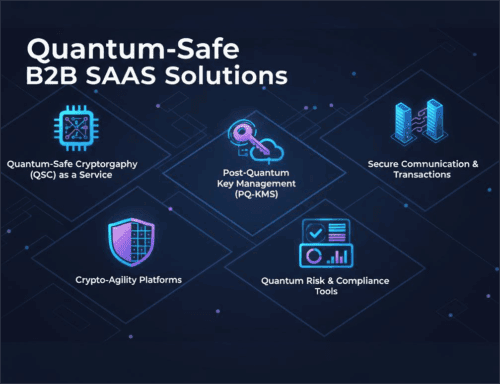
1. Quantum-Safe Cryptography (QSC) as a Service
Companies are using SaaS platforms that include PQC algorithms (lattice-based, hash-based, and code-based methods) right in their workflows. Vendors are packaging this as plug-and-play APIs for:
- Cloud storage providers
- Rails for financial transactions
- Platforms for secure messaging
Impact: Enterprises can upgrade to PQC without rebuilding their entire infrastructure.
2. Platforms for Crypto-Agility
The future is unclear; PQC algorithms may change, and businesses don’t want to be locked into a vendor. Crypto-agility solutions make it possible to:
- Switching between encryption methods without any problems
- Hybrid models (classical + quantum-safe running in parallel)
- Automatic key upgrades when standards change
Impact: Enterprises can adapt without massive migrations every few years.
3. Post-Quantum Key Management Systems (PQ-KMS)
Keys are the most important part of business security. New SaaS-based key management solutions are:
- Giving quantum-safe algorithms the ability to change keys on the fly
- Working with cloud HSMs (Hardware Security Modules)
- Giving regulators compliance logs that are ready for an audit
Impact: Makes security future-proof and easy to audit, which is very important for banking and healthcare.
4. Tools for Quantum Risk Assessment and Compliance
Enterprises don’t simply need encryption; they need roadmaps. New B2B SaaS products include readiness scorecards, which measure quantum resilience.
- Compliance dashboards that follow the rules set by NIST, ISO, and EU ENISA
- Simulation models highlight how quantum attacks could affect current systems.
Impact: CIOs and CISOs get a clear plan and story for investment at the board level.
5. Platforms for safe communication and transactions
Quantum-safe VPNs are based on PQC tunnels for business traffic.
- Quantum-proof financial transactions → secure rails for banks and payment processors
- Enterprise messaging apps → incorporating PQC to protect sensitive communications
Impact: It protects the “everyday” flows of business communication that are most likely to be lost.
Case Examples in Motion
Banks and Other Financial Institutions
Some of the world’s biggest institutions are starting test projects with post-quantum transaction rails. These systems are made to conduct a lot of financial transactions quickly while keeping the encryption safe against quantum attacks.
Why they care:
Long-term data theft is most likely to happen in the financial sector. A quantum breach could compromise decades of archived payment records, client credentials, and trading algorithms.
What they are doing:
Working with fintech SaaS companies that offer quantum-resistant APIs to make payments safe.
- Using both classical and PQC encryption models during the changeover.
- Testing conformity against early post-quantum financial norms imposed by central banks.
Impact: result is that banks are not only preserving their customers’ money, but they are also showing investors that they can be trusted and are ready for the future.
SaaS for Healthcare and Hospitals
Ransomware and data breaches often happen in the healthcare industry. In a quantum world, electronic health records (EHRs) and genomic data are in a lot of danger.
Why they care:
In the US, HIPAA (Health Insurance Portability and Accountability Act) protects patient privacy, and in Europe, GDPR does the same. A breach might lead to both a loss of reputation and fines of millions of dollars.
What they’re doing:
Healthcare SaaS companies are adding post-quantum cryptography APIs to their telemedicine and cloud storage platforms.
- Hospitals are testing quantum-safe VPNs to let departments talk to each other.
- Startups are offering crypto-agile SaaS solutions to tiny clinics that lack in-house IT skills.
Impact: Patients feel more sure that their health data will stay safe for a long time, even after 2030, when technology changes.
Government Agencies and Defence Contractors
Defence and national security groups deal with sensitive intelligence that needs to stay hidden for decades. A modest data leak now could be a big deal when quantum decryption gets better.
What they care about:
Military blueprints, satellite communications, and cyber-defense strategies must stay secure for 30–50 years.
What they’re doing:
Transitioning to crypto-agile frameworks that allow quick upgrades of encryption standards without rebuilding systems.
- Testing communications networks that are safe for quantum for use in the field.
- Working with specialised B2B SaaS providers who provide secure communication platforms that meet PQ standards for defence projects in several countries.
Outcome: Defense players are establishing a long-term strategic shield, guaranteeing communications and data remain beyond the reach of attackers – both today and in the quantum future.
Market Outlook & Enterprise Adoption Curve
- 2025–2026: Early adopters in banking, defence, and healthcare start using PQC APIs and crypto-agility tools together.
- 2027–2029: Regulatory agencies begin demanding quantum-safe relocation plans for important businesses.
- In 2030: quantum-safe encryption will be the standard, just like HTTPS is now.
For people who start SaaS: This is a great time to create PQC-aligned services and join corporate vendor stacks.
BuzzMora POV:
Businesses can’t afford to put off thinking about post-quantum security. The actual concern is brand trust erosion: if tomorrow’s quantum technologies decrypt today’s data, customers will not forgive.
- The chance for B2B SaaS companies is huge:
- Create a crypto-agility SaaS that works with business apps.
- Give developers drop-in modules that are ready for PQC APIs
- In a congested market, make your product stand out as the one people can trust.
We at BuzzMora think that success isn’t just about making tech that is safe from quantum attacks; it’s also about building trust. Businesses need to help customers move from awareness to trust to adoption by giving them the correct information, education, and proof. That’s where our AI + Funnelism method comes in to help people go from new ideas to using them.
BuzzMora’s point of view on case studies:
These examples indicate that quantum readiness is no longer theoretical – it’s in active motion throughout banking, healthcare, and defense. What they all have in common is that they are both focused on:
- Technology: Using solutions that are ready for PQC.
- Trust: Making sure stakeholders know that their most private information will stay protected.
- SaaS: owners and B2B marketers a way to position themselves:
- Finance: Talk about investor trust and compliance in finance.
- Healthcare: Stress patient safety and rules.
- Defense: prioritise strategic resilience.